A text regarding stubbornly insisting on writing Jo'on's name a certain way
If you browse the Touhou Wiki or official community spaces today, her name is spelled Joon Yorigami.
Yet throughout my GTA San Andreas mod, my code, my commit logs, and my notes, I consistently write it as Jo'on.
Typing four letters without an apostrophe is obviously faster and easier. So why go out of my way to keep that extra punctuation mark?
Let's be completely, brutally honest: half of it is linguistic justification, and the other half is imageboard muscle memory. When you spend a long time typing yorigami_jo'on into a search bar next to an artist's name to filter their works, your fingers literally refuse to type anything else.
It is not an accident, and it is not an attempt to correct anyone. The official standard is "Joon", and there is solid primary-source evidence for why people use it. But in my own creative corner, I stay stubborn.
The origin of the official spelling is from ZUN himself
To be completely fair to the translators and wiki editors who standardized her name as "Joon," their reasoning is entirely solid: ZUN wrote it that way himself.
During Reitaisai 15, ZUN made an official event omikuji slip featuring a sketch of Jo'on grinning and shouting:
「お前はラッキーだ!」 ("You're lucky!")
Directly beneath her is the bold result: 大凶 (Daikyō), translated underneath in English as Miserable. The printed text below cheerfully offers condolences, warning the person who pulled the slip that a pestilence god will cause them to waste their money at the convention and drop excessive funds on mobile smartphone gacha apps.
Right between the sketch and the word "Miserable," ZUN penned her name in Roman letters: Joon.
Digging into the Touhou Wiki's revision history shows that they didn't even hesitate: on December 29, 2017, literally thirty minutes after Antinomy of Common Flowers dropped at Comiket 93, the wiki page was moved from Jyoon (from the game's omake.txt) to Joon Yorigami.
When a franchise creator hand-writes an English spelling onto an official slip and the game files back it up, it makes total sense why documentation spaces standardized around it.
So why does some part of the internet keep the apostrophe?
English phonics, Hepburn rules, and syllabic speedbumps
The primary linguistic reason for keeping the punctuation comes down to how Japanese phonetics collide head-on with English spelling habits.
In Japanese, her name is written in kanji as 女苑 and spelled in kana as
じょ・お・ん.
It consists of three distinct morae:
- Jo (じょ)
- O (お)
- N (ん)
It is not a single prolonged vowel like Jun (じゅん), and it is not a sliding diphthong. It is a distinct transition across a mora boundary: Jo-on.
Here is where the technical romanization rules get interesting. If you look at textbook Modified Hepburn, the official rule for adjacent vowels across a morpheme boundary (two separate kanji or root words) states that identical vowels are written simply by repeating the letter without a macron:
小 (ko) + 躍り (odori)becomes koodori (not kōdori)邪 (ja) + 悪 (aku)becomes jaaku (not jāku)
Because her name is made of two distinct kanji morphemes, 女 (jo) + 苑 (on), strict Modified Hepburn dictates that O + O across that boundary is written as a double-O without a macron: Joon.
On paper, the wiki editors who follow strict Modified Hepburn are following the rulebook to the letter.
However, strict adherence to that rule creates immediate friction with English phonology.
The original purpose of James Curtis Hepburn's system was to use English spelling conventions so foreigners could pronounce words accurately. Yet in English orthography, a double "o" represents the vowel sound found in words like moon, spoon, food, or spooky (IPA: /uː/).
As a result, when an uninitiated English speaker sees "Joon", their brain does not process two separate morae. They instinctively read it as /dʒuːn/, making her name sound identical to the calendar month of June.
To resolve this issue, professional translators, academic presses, and localization teams frequently apply a phonetic boundary marker (or hiatus marker).
While textbook Hepburn officially codifies the apostrophe only for syllabic n before vowels (such as writing kan'i for 簡易 so readers do not say ka-ni), translators regularly extend this punctuation to vowels in proper nouns to prevent severe English phonetic collisions. A classic historical example is writing Go'on for 呉音 (the historical Buddhist reading of kanji), specifically so English readers do not pronounce it like the English word goon.
Writing her name as Jo'on introduces that exact same necessary speedbump.
That tiny apostrophe signals to an English reader that the word is split into two sounds, guiding them to say Jo-on rather than June. For me, hearing the correct three-mora cadence of her name matters, and the apostrophe does that job reliably.
Five-letter twin symmetry
The second reason is purely aesthetic, especially from a user interface and programming perspective.
Jo'on and Shion are conceptually twins:
- Blue flame and golden flame.
- Active consumption and lingering aftermath.
- Two equal halves of the same event of ruin.
When written with the apostrophe, their names achieve exact character length parity:
- S - H - I - O - N (5 characters)
- J - O - ' - O - N (5 characters)
When coding their names in Sanny Builder for YORIGAMI SYNDICATE and having them appear as text in GTA San Andreas (~b~Shion: vs ~y~Jo'on:), having both names occupy the exact same horizontal character width creates a clean, pleasing visual balance on screen.
Writing "Joon" reduces her to 4 letters, creating an uneven visual hierarchy between twin characters. The apostrophe preserves the visual weight between both sisters.
It's fancy! So I'm keepin' it!
From a purely character-driven perspective, the apostrophe fits Jo'on's personality.
Jo'on is obsessed with looking expensive, foreign, and high-class. She wears an expensive-looking purple rose-patterned jacket, carries branded bags, and wants everyone to believe she belongs in an elite social tier.
To my eye, "Joon" looks plain and utilitarian. By contrast, Jo'on has an eccentric, slightly elevated typographic flair. It looks stylized, like the punctuation you might see in a luxury fashion label or an imported perfume brand. It feels like an extra detail she would insist on keeping on her business card purely out of personal vanity.
Let's imagine the first time Jo'on landed in San Andreas. She shows people her business card, and people say: "Hey, June!"
I think she would immediately fist-fight someone in the parking lot for that:
"It's JO-ON, dammit! What's with everybody callin' me JUNE?!"
But that's just my childish imagination.
The real culprit: Danbooru muscle memory
Now for real this time: Danbooru ruined my hands.
When Antinomy of Common Flowers dropped in late 2017, the booru communities widely utilized "Jo'on" to prevent the "June" mispronunciation.
Because of that early convention, major image archives permanently established her character tag as:
yorigami_jo'on
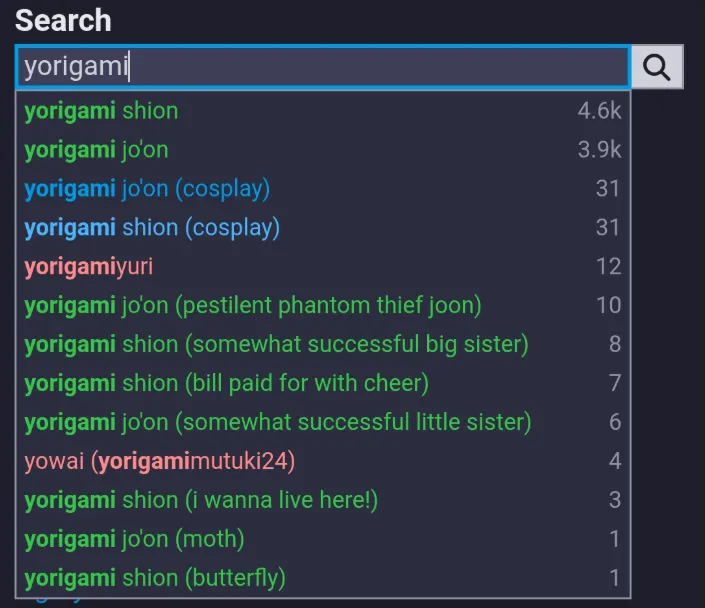
Look at that search dropdown. There it is: yorigami jo'on (3.9k), sitting right underneath yorigami shion (4.6k).
In large database systems, changing established primary keys is avoided because it disrupts years of indexing and search queries. If you go to Danbooru right now and type yorigami joon, the search engine literally looks at you like you made a typo.

For those of us who spent years digging through the imageboard trenches looking for art and inspirations, typing that apostrophe became an involuntary motor reflex. My fingers physically type J - O - ' - O - N before my conscious brain even realizes what I'm doing. It doesn't matter if my hands are on a keyboard or typing on a smartphone screen. My fingers will stubbornly, painstakingly type that apostrophe.
If I may speak my mind without shame, typing Jo'on's name with the apostrophe feels like a prayer to the Pestilence God. But that's just me being foolishly self-indulgent in my maladaptive daydreams.
Alright, that's enough rambling for now
Neither spelling is wrong; they simply serve different purposes.
- Joon honors the creator's handwritten convention slip and satisfies strict Modified Hepburn tables.
- Jo'on preserves the three-mora pronunciation for English speakers, maintains visual symmetry with Shion in game code, fits her luxury vanity, and keeps my booru searches working.
I respect the official standard, but in my own creative corner, I'm keeping the apostrophe. It looks right, it sounds right, it balances her sister on the screen, and my keyboard refuses to type it differently.
-- EagleRaviOrange