【東方・Touhou】Linguistic analysis and unhinged commentary for the rest of the lyrics of ヨリガミサマ (Yorigami-sama) by RD-Sounds
The full Japanese lyrics, Romaji, and my English localization of the spoken dialogue can be found on this Reddit post or this mirror post if you are interested in reading the complete sheet along with the song.
This post is dedicated to my analysis, thoughts, and commentary on the lyrics themselves.
Lyrical breakdown
Beyond being a character duet, the lyrics of ヨリガミサマ (Yorigami-sama) from RD-Sounds' album 契 (Chigiri) are built on specific Touhou canon references, classical grammar, and layered Japanese wordplay. Much of the sisters' dynamic is established through linguistic contrasts embedded directly in the text.
Opening with a homophone contrast (生る vs. 鳴る)
The opening couplet establishes the opposing domains of both sisters through homophones:
誰が為のカネが生る
Dare ga tame no kane ga naru
(For whose sake does the cash roll in?)抱える空きっ腹の鳴る
Kakaeru sukippara no naru
(Holding down a starving, growling gut.)
The first line, 誰が為のカネが生る, is an overt parody of the standard Japanese title of Ernest Hemingway's novel For Whom the Bell Tolls (誰がために鐘は鳴る, Ta ga tame ni kane wa naru). RD-Sounds swaps the church bell (鐘, kane) for slang for money (カネ, kane).
Both lines end with the identical phonetic reading, naru, but contrast each sister through the kanji choice:
- Jo'on's line uses 生る (naru), meaning to bear fruit, yield, or generate, reflecting her ability to force financial assets into existence.
- Shion's line uses 鳴る (naru), meaning to ring, chime, or rumble, describing the sound of her empty stomach while echoing the original Hemingway title.
The wordplay around the root sound "yoru"
On X (formerly Twitter), RD-Sounds noted that the core thematic seed for this track was a single Japanese sentence:
「寄る辺のない世界だから寄り添うように生きるヨリガミサマ」
(The Yorigami-sama who live huddled together because it is a world with nowhere to belong.)
Throughout the choruses and the final verse, the lyrics iterate through multiple linguistic variations of the sound yoru:
- 依神 (Yorigami): Their surname. The kanji 依 means to rely on, depend on, or possess (as in AoCF's Perfect Possession, 完全憑依 / kanzen hyōi).
- 寄る辺のない / 依る辺のない (Yorube no nai): A traditional phrase meaning having no protector, no one to rely on, and nowhere to belong. While the first chorus uses the standard 寄 (
寄る辺のない), the final verse substitutes the 依 from their surname (依る辺のない). - 夜辺 (Yorube): Used in the second verse (
夜辺を征ける暗がりに, Striding through the dead of night). It combines the kanji for "night" (夜) and "edge/side" (辺), matching the exact reading of yorube. - 寄り合い (Yoriai): Gathering together or forming an association of outcasts.
- 寄り添う (Yorisou): Physically nestling close together, huddling for warmth, or supporting one another side by side.
Subverting polite phrases (オカゲサマ and オタガイサマ)
The choruses integrate two standard Japanese conversational stock phrases, shifting their everyday social meanings into gallows humor:
- オカゲサマ (Okagesama): In standard polite society, this phrase means "thanks to your help" or "by the grace of providence." Here, it follows 厄日 (yakubi, an unlucky day, sung as konnichi, today): "An unlucky day, yet having this day is all thanks to you!" It flips a formal expression of gratitude into wry sarcasm, basically saying "today is godawful again thanks to you."
- オタガイサマ (Otagaisama): The standard phrase for "the feeling is mutual" or "we're even." In the song, it immediately follows
貶し罵詈雑言せば(Hurling insults and shouting abuse), shrugging off their vicious screaming matches as just being even.
Treating a curse like an heirloom (肌身離さぬ呪い)
In the second verse, the lyrics describe their condition with a specific idiom:
肌身離さぬ呪いがここに
(A curse held close like a cherished keepsake stays right here!)
The expression 肌身離さず (hadami hanasazu) carries a distinct everyday meaning: to keep an object physically touching one's skin at all times. It is used almost exclusively for protective amulets (omamori), family heirlooms, wedding rings, or beloved keepsakes worn under clothing.
Pairing this phrasing with 呪い (noroi, curse) is an intentional subversion. Instead of treating misfortune like an affliction to be driven away, the lyrics frame their curse as a personal keepsake they carry directly on their person.
The grammar and meaning of "michizure"
Near the climax, the vocalists deliver this declaration:
ならば行こうぞ 地の涯て迄ともに道連れよう
Naraba ikō zo, chi no hate made tomo ni michizureyō
(Then let's go, dragging each other straight to the ends of the earth!)
The term 道連れ (michizure) has two distinct applications in Japanese:
- A literal traveling companion on a road.
- The act of dragging someone else down into your own ruin, failure, or death (as in a double suicide or taking an enemy down with you).
Grammatically, michizure is strictly a noun. Standard Japanese requires the construction michizure ni suru ("to make someone a fellow casualty"). In this lyric, RD-Sounds forces the noun into a volitional verb: 道連れよう (michizureyō). This grammatical shift turns an unfortunate circumstance into an intentional, aggressive pact: both sisters actively dragging each other into whatever disaster comes next.
Gikun: text on the page versus vocals in the track
RD-Sounds frequently employs gikun (writing kanji for visual context while instructing the vocalists to sing a different word). Several key lines in ヨリガミサマ use this technique to add secondary meaning (Referenced from Japanese RD-Sounds wiki):
厄日(Unlucky day) sung asこんにち(Konnichi, today): To normal people, a day of misfortune is an exception; for these two, an unlucky day is simply their everyday reality.暗黒(Total darkness) sung asせかい(Sekai, world): In the line誰もが知らぬ深い暗黒を見る, the written text uses 暗黒 (pitch-black darkness), while the vocalists sing せかい (world).吸う(Inhale / draw in) sung asのろう(Norou, curse): In己の窮乏を吸う目に, the printed lyric uses 吸う (to breathe in, suck, or absorb), while the sung audio reads のろう (to curse).罵詈雑言せば(Hurling verbal abuse) sung asかしま・せば(Kashimaseba, raising a clamor): The written kanji denotes harsh insults and verbal abuse (barizōgon), while the sung reading plays on the adjective kashimashii (noisy or clamorous).
If you are only here for the lyrical analysis, feel free to stop here.
Everything past this point is pure personal musings.
...
...
...
Eh? You're reading this far? Well, okay.
With that said...
So, while I localized (not just translated 1:1) the lyrics for English consumption, I couldn't shake the feeling of how... strangely sensual and lovey-dovey some of the words RD-Sounds chose in writing the original Japanese lyrics were.
For starters, when you look up the word 寄り添う (yorisou), Google Images gives you soft-focus sunset stock images of a couple leaning against each other, one resting their head on the other's shoulder, cuddling, holding hands side-by-side, snuggling, nestling.
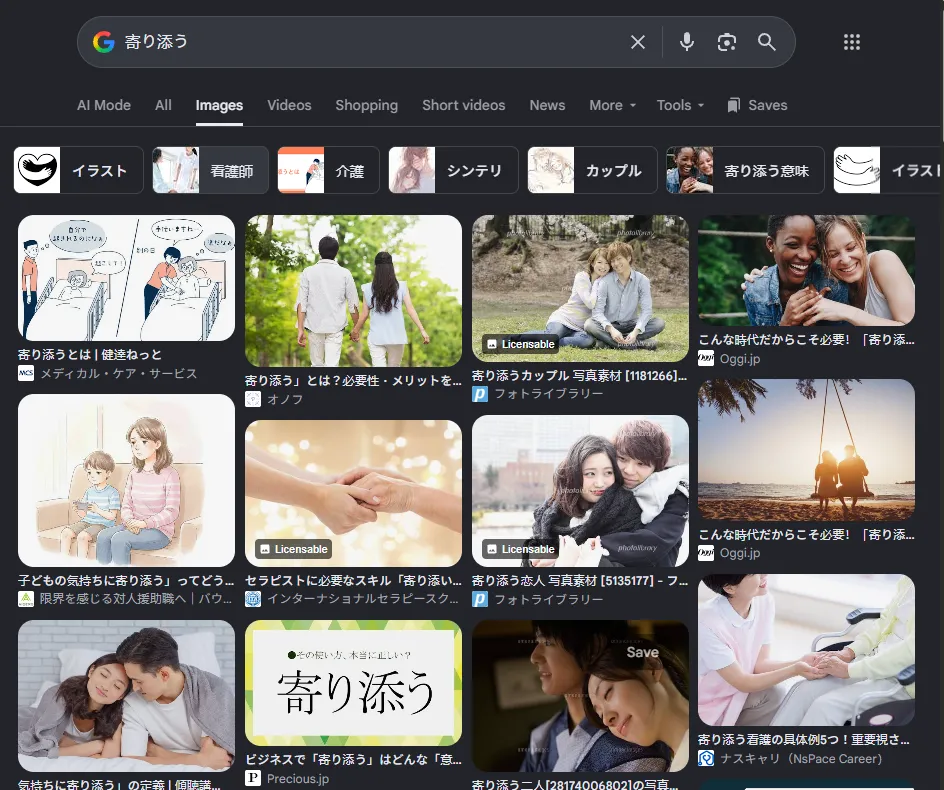
And look at the second kanji in that word: 添う (sou). It is the exact same character used in 添い寝 (soine : sleeping/cuddling side-by-side in bed) and 連れ添う (tsuresou : living together as lifelong partners or spouses). It implies actual body weight and physical warmth pressed up against each other.
And it doesn't even stop there! Look at the literal title of the entire album: 契 (Chigiri), which shows up right in the song's climax: 忘れまじこの契り.
The entire concept of the album Chigiri revolves around different kinds of vows and promises between pairs of characters:
- Renko and Merry's uncertain future after college (a promise that might not last a lifetime).
- Mokou and Kaguya's endless fighting (an eternal promise).
- Ariya's lonely persistence (an unfulfilled promise).
- Koishi and Satori's strained connection (a one-way promise).
- Reimu and Marisa's unspoken routine (a promise that doesn't even need to be made).
Note: These exact "promise" descriptions are borrowed from a Japanese fan's track commentary titles, which I will get to right below.
And then right in the middle of all those legendary relationships sits ヨリガミサマ: a mutual, dirty pact between two outcasts dragging each other down into the muck.
In dry English, sure, chigiri translates to "vow" or "pact." But in classical Japanese literature, 契りを交わす (chigiri o kawasu) is the age-old poetic euphemism for lovers exchanging vows and consummating a lifelong relationship. Having that word dropped at the absolute emotional peak of a song about two sisters who refuse to leave each other's side makes the subtext impossible to ignore.
As I read the lyrics sheet, even understanding the entire surface context is about two despised gods surviving the world, the words themselves bring an undeniably sensual connotation.
And then... I found this Note article by Toran-san.
とらん's commentary on RD-Sounds' album 契
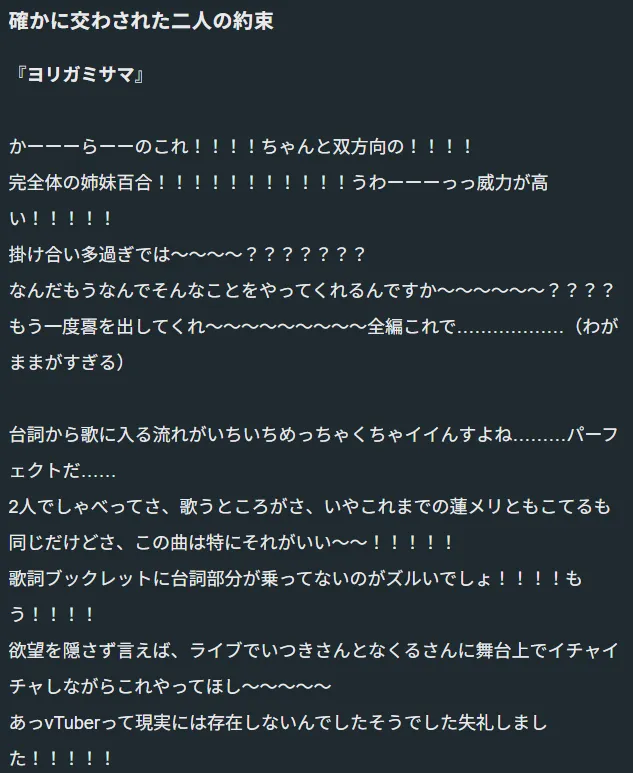
Toran structures their entire review by categorizing each song on the album under a specific type of promise (which is where the descriptions in my list above came from). They give the Yorigami track the section title 「確かに交わされた二人の約束」 (A promise truly exchanged between the two of them), setting it directly against Satori and Koishi's one-way promise (一方通行な約束) right before it. And then they immediately go wild over how bidirectional it is:
かーーーらーーのこれ!!!!ちゃんと双方向の!!!!完全体の姉妹百合!!!!!!!!!!!うわーーーっっ威力が高い!!!!!
(And then coming off that: THIS! A properly BIDIRECTIONAL! Complete-form sister yuri! Uwaaa, the firepower is too high!)
They even throw shade at the Komeijis in Chireiden, saying Satori and Koishi need to look at Jo'on and Shion actually fighting once and properly making up afterward (いやもうどっかの旧地獄の館のおねえちゃんと妹はこれを見てくださいよ).
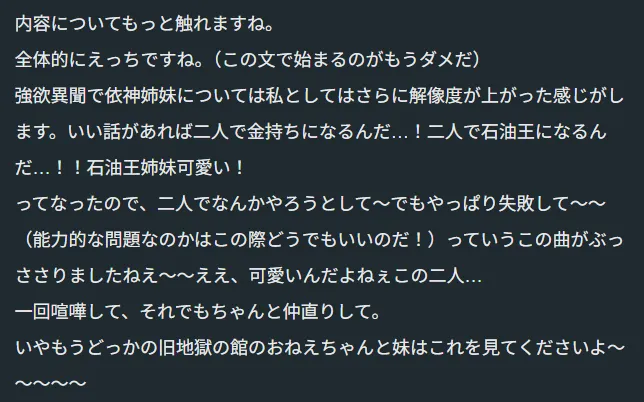
And then, right when they start analyzing the actual content of ヨリガミサマ, the very first sentence out of their mouth is:
全体的にえっちですね。(この文で始まるのがもうダメだ)
Overall, it's pretty erotic. (Starting the paragraph with this sentence is already a lost cause.)
I FUCKIN' KNEW IT.
I wasn't imagining things!
A native Japanese speaker heard the exact same heat coming off the lyrics and the voice acting!
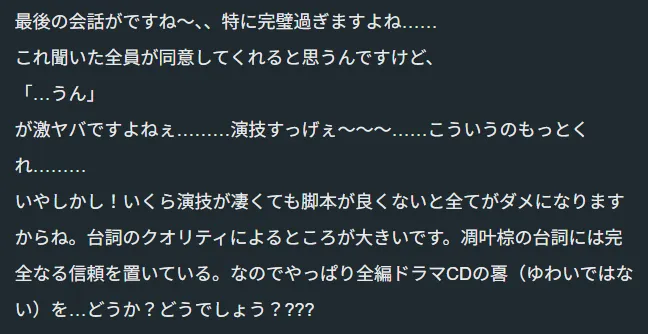
Because look at what happens at the end of the track: Jo'on storms out saying she doesn't need an older sister, fails on her own, drags herself back home, and when Shion smiles and says "Let's go raise hell together", Jo'on drops all her loud 80s delinquent swagger and softly whispers a single, breathy 「…うん」 ("...Yeah").
Even RD-Sounds admitted on X that he specifically structured the drama so Jo'on comes crawling back and ends the track しおらしく (shiorashiku : meek, subdued, docile). Having Itsuki Natsume (棗いつき) and Nakuru Aitsuki (藍月なくる) act that entire fight and quiet reconciliation right into your headphones is lethal.
Toran was down so bad after hearing that final …うん (which they called 激ヤバ / geki-yaba : insanely dangerous) that they literally begged RD-Sounds to release an entire full-length drama CD dedicated to these two: "How about it? Please? What do you say????" (全編ドラマCDを…どうか?どうでしょう????), right after daydreaming about the two vocalists performing the whole track live on stage acting all lovey-dovey (イチャイチャ) before recalling VTubers aren't real.
And then, right in the middle of losing their mind over the voice acting, Toran drops this complaint:
歌詞ブックレットに台詞部分が乗ってないのがズルいでしょ!!!!もう!!!!
(Not printing the spoken dialogue in the lyrics booklet is so unfair! Geez!)
WELL BUDDY I GOT GREAT NEWS FOR YOU!
-- EagleRaviOrange